Friday, 18 October 2013

Pompeii and Herculaneum: A Late Review and a Bit of Background


I finally got round to seeing the British Museum's Life and Death in Pompeii and Herculaneum exhibition last month (just before the exhibition closed) and I have to say, that was fantastic!

I'd finally been able to plan a day when I would be in London so was able to book in advance and walked straight into the exhibition. After walking along a dark winding corridor (purposefully reminiscent of the Mausoleum of Hadrian in Rome?) you arrive at an audio-visual introduction to the exhibition, detailing the history of the excavations and the kinds of objects that have been found.

Most exciting of all was how the exhibition space had been planned - constructed in the shape of a 'standard-type' Roman house, (I think perhaps modelled on the plan of the House of the Tragic Poet in Pompeii), each 'room' of the exhibition reflected the objects and function of that part of the house.

The exhibition certainly focused on the 'Life' in Pompeii and Herculaneum, bringing together an atmospheric street-front with a detailed domestic interior, much of which included items from museums all over Europe, so it was particularly thrilling to see them all in one place, which really gave a good impression of what real Roman life was actually like.

A carbonised loaf of bread, stamped by the baker, from the cucina (kitchen) of a Roman house.
The 'Death' aspect was certainly more serious, and took up less of the exhibition, and perhaps rightly so. When I was last in Pompeii (not that regular an occurrence, honest!) I was with a group of Classics students and we decided that we didn't need a map as we had studied these streets and could find our own way. Our confident attitude apparently meant that we were a magnet for American tourists, who would come up and ask "where the bodies" were. For a start, the "bodies" are plaster casts, filling the empty space caused by decayed organic matter that was encased in volcanic ash, but more importantly why, when you're visiting a very special heritage site like Pompeii, would your main concern be the physical remains of humans? It just felt very morbid. And meant that visitors were less interested in the fantastic wall-paintings and mosaics of the buildings than they were in seeing dead people. Anyway ...

I was pleased that the British Museum exhibition didn't focus too much on the 'Death' side of the exhibition, other than to point out that it was a particularly tragic event, where whole families died suddenly, as the casts at the end of the exhibition showed.

Perhaps of more interest to a specialist, is the question of 'what happened after Vesuvius?', which was not really asked in the exhibition. Well, the work of projects such as the Apolline Project, which I took part in a few summers back, aims to show that there were more settlements up and down Vesuvius than just Pompeii and Herculaneum. Evidence from a post-AD 80s site also shows that resettlement of the area, according to brickstamps, actually occurred within 15-20 years after the well-known eruption. Certainly the Vesuvian eruption was a tragedy, but life had to continue.

The 'Villa with Baths', Pollena Trocchia, excavated by the Apolline Project.
All in all I was very excited to actually attend the exhibition, and very impressed with its scale and treatment of the topic. I was a little disappointed by how crowded it was, making it difficult to move round, but that perhaps shows how much this exhibition captured the public interest (and how people want to feel as though they have got the most out of their money!)

Wednesday, 27 March 2013

"Sex and the Satyr"

As a follow-up to what I wrote yesterday, this is what the Daily Mail thinks of Roman sex ... (And I have to say, I wish that I'd come up with 'sex and the satyr').

It's a shame, actually, that the DM finds it necessary to use shock headlines to capture interest as, despite the odd factual inaccuracy and an over-blown description of the eruption that both Pliny the Younger and Mortimer Wheeler would be proud of, the article is not that bad (!).

It does try to focus on the human side of the exhibition, (having pulled the reader in by highlighting the Romans' "hedonistic" habits), detailing individual stories, the lives of families, and, of course, individual brothel prostitutes. (There were probably not as many brothels as have been previously thought. Just because a building has small cubicula and erotic paintings does not necessarily mean that it's a brothel).

As Paul Roberts, who is senior curator of the exhibition, points out, the phallus was a protective symbol of luck and, rather than being shocked by the statue of Pan and the goat, the Romans would have found it amusing. And so should we. It presents a lightness and a sense of humour amongst the casts of dead families and the carbonised remains of daily life.

As, thankfully, the Guardian emphasises, we should not be viewing this exhibition as 'sinful'; these are facts of every day life and entertainment. And that doesn't mean we can't enjoy them, either appreciating them for their artistic value, their historical interest, or simply because we find them 'a bit naughty' today.

And in case you missed that image, here it is again, courtesy of the DM:

[Edit] And to add, with reference to this article, that if divine epiphany was the purpose of gods appearing as animals and having sex with women (and not just amusing stories of horny gods), then this piece is even more (pardon the pun) satirical. Satyrs, like pygmies, were frequently used in Roman art to create a mockery of situation. Here the divine epiphany is turned on its head, with the god-like satyr having sex with an animal, rather than taking the full form of the animal itself. Come on, it's amusing!

Tuesday, 26 March 2013

Five Stars in Pompeii and Herculaneum

Life and Death in Pompeii and Herculaneum
28th March - 29th September
British Museum, London

I am excited about this, I have to say. The exhibition opens on Thursday and I can't wait for the excuse to go and see it next time I'm in London.

Vanessa Baldwin, who was on my undergraduate course at university, is actually co-curating the exhibition (I'm only a little bit jealous), and has even co-written the guide book to go with it! Knowing her, I'm convinced it's going to be good.

The whole point is that this exhibition is about daily life, rather than public spectacles, theatres or famous statues. We can expect commonplace items, such as tables, which have been remarkably preserved in the ash of Vesuvius in the eruption of AD 59.

I've had a look at some of the objects that are being featured:

Terentius Neo and his wife
Terentius Neo, baker, and his wife. AD 50-79.
Not only is this a lovely portrait of a man and his wife, it is also exceptional for being a portrait. This represents the people who actually lived in this house, the man staring straight out at the viewer, his wife's eyes slightly averted. She also has a stylus pressed to her lip in a contemplative gesture, whilst he rests his chin on a scroll. This shows how they are not only thinking, but they are also able to think, to read and to work, which was also a sign of just how successful a baker he was. She also holds a wax tablet, which shows that she was involved in the business side of the bakery. It shows how educated this pair were, (or how educated they wanted the viewer to think they were) and it is both delightful and unusual to find such a portrait preserved in a Roman house.

House of the Golden Bracelet fresco:
House of the Golden Bracelet, Garden fresco.
This lovely fresco was found along the wall of the triclinium (dining room) of a large town-house. This particular scene shows an open and fantastical garden, populated by all kinds of species of birds, so to seem as though the dining room itself was open to a garden. The 'heads' hanging from the sky are in fact theatre masks, which reflect a flimsy theatre-like structure painted above this open scene. Painted women recline in the rectangular pictures, supported by the heads of herms, making this garden something of a picture gallery - a pinakothekai - in this fantasy garden.

Pan and goat:
Pan and goat. (see Telegraph article)
Don't be prudish, this is sex and sex is amusing and fun. Notice how Pan even seems to be leaning tenderly over the goat, as if reassuring her that everything will be ok? This piece is bound to get a few giggles in the exhibition. It completely throws us as we have no idea whether to take it seriously or as a joke. Normally is it confined to the 'Secret Cabinet' room of the Naples Museum. I can't wait to see how they explain this piece. The phallus was seen as a lucky object, and fauns were naughty, cheeky and sexually depraved. They were also part-goat. So really, I see this as an amusing talking point in a Roman garden, not meant to shock, but just, titillate.

In any case, I'm excited for the new exhibition and can't wait to see what objects have made it out of Italy to amuse and interest us in the UK.

Reviews of the exhibition can be found here:
http://www.bbc.co.uk/news/entertainment-arts-21938225
http://www.bbc.co.uk/news/entertainment-arts-21897925

Monday, 25 March 2013

Digging Deeper: Whatever Happened to 'Time Team'?

With the last ever episode aired last night, barring a few special editions, I still can't understand why Time Team had to end.

I grew up watching Time Team. It was part of my Sunday evening TV as a child. As I grew older I would come home from working in a café on a Sunday and watch it whilst making dinner. I didn't see much of it whilst at university, (lack of working television is definitely a factor here), but with catch-up websites such as 4oD, there was never really that much of an excuse.

But even to me, it feels like a show that belongs in the 1990s, with garish jumpers, scruffy hair and trips to the pub. Like watching Last of the Summer Wine, but with a factual element. (Not to say that these features didn't make it great at the time; they were part of its character).

Reading an article in The Guardian, it seems like Channel 4 had just run out of patience with the show. They gave it some (I'd like to think) well-meaning last-ditch attempts at hiking up its viewing figures: the establishment of the Time Team club, where one lucky member a month could take part in a dig, adding a new presenter, trying to 'jazz up' the format (and losing Mick Aston as a result). 

1.5 million viewers was apparently not high enough, having reached a peak of 2.5 million in 2008 (compared to repeated episodes of shows like Come Dine with Me reaching 1 million viewers during the day time). But after 5 years of attempting re-vamping, was cancelling the series really the best decision?

Mick Aston accused the show of "dumbing down" and "pratting about", which really did seem to be the problem with some of the newer episodes. In my opinion, it wasn't that people found the old format unintelligible, it was that the show had all the edge of a well-used trowel and had just become boring and predictable, regardless of the site upon which they were working.

It wasn't that the show needed more glitz and glamour to increase viewing numbers; the essential format worked and archaeology shows remain popular, as the BBC has found out. What was missing was the excitement and relevance that comes with archaeology in the 2010s:


  • There are breakthroughs in archaeology (both academic and practical) every day, exciting excavations and reconstructions such as the recent work on Richard III are just part of that, and it seems such a shame that Channel 4 is closing this window on the archaeological world. Time Team lost its relevance because it existed in its 90s bubble, without reference to the rest of the archaeological world.
  • Time Team did not need to be just a three-day long dig; as a generalisation the most interesting finds only came up on the third day, by which time the Team had cleared off to the pub. Why was the show not made longer, so that we could really see what that entire Iron Age village might have looked like?
  • Experimental and reconstruction archaeology has become a Big Thing. And who doesn't enjoy seeing how things were made in ancient times? Ever see Two Men in a Trench, which pushed Neil Oliver onto our tv screens? It was ridiculous, but I learned things, and I loved it!
  • There are incredible excavations going on in Britain throughout the year. Vindolanda, York, Dorchester (hey, I like Romans). I don't remember local museums, local relevant digs or anything like that coming in to the show. Local societies were featured, but only because they asked the Team there in the first place.
  • And why not feature some of the archaeologists as individuals and names? I wanted to know who these people were, how they became archaeologists and how they knew how to use a trowel. 
For me, as one of those missing viewers after 2008, Time Team had lost its relevance.

The Daily Mail referred to Time Team as "Tony Robinson's archaeology series". Is that all it ever was? Tony Robinson was certainly a lead figure, and we can't expect him to continue presenting a series forever. After years of watching the series, I began to find his presenting manner irritating. His foolish style was no longer amusing, and I began to believe that after his many years on the show, that he had learned nothing about the field. And perhaps that is what the Channel 4 producers had forgotten about the viewers; we learned and grew up alongside Time Team, and many of us have dabbled in archaeology because of it.

So, Channel 4, I put it to you: where is our archaeology programme? What will you fill our viewing hours with instead? Why not start again, without Tony Robinson, and with real archaeologists, excavating sites that have real relevance? Why not, for example, see a dig through all the way to the end? And why not give an archaeology programme the chance to capture the hearts and minds of the next generation of wannabe archaeologists?

Thursday, 4 October 2012

A Little Something What I Wrote ...

So, I did a bit of work experience with Current World Archaeology magazine (which was lovely - really nice people) and they let me write a little something for them:

http://www.world-archaeology.com/blog/digging-on-the-dark-side-of-vesuvius/

It's based on the Apolline Project, which is an excavation I went on during July 2011. It was a really interesting dig and they've made a lot of progress recently, establishing that it is the site of a large Roman villa.

It all looks set to continue next year, with further excavations into the villa, and the possibility of even more interesting finds. I hope to be joining them!

http://www.apollineproject.org/
http://bloggingpompeii.blogspot.co.uk/

Thursday, 6 September 2012

Time for an update

So, new plan for this is to start writing reviews. I've been to quite a few historical places. This includes museums, and Roman villas and even other countries! So I might as well write about my experiences with archaeology and hope that other people find it useful.

That's the plan anyway. Yeah.

More to follow (hopefully) soon ...

Wednesday, 4 July 2012

Books! (Roman Art and Archaeology)

So let's have ourselves a list of books that are generally archaeologically awesome ...


Roman Art and Archaeology
Rome: An Oxford Archaeological Guide to Rome - A Claridge.
This book is fasntastic. It gives an overview of all the extant monuments of the city of Rome (which is perfect if you're visiting it or studying it). Some of the opinions can be a little outdated, but Claridge often updates the book. It also pairs well with F. Coarelli's Environs of Rome.


Roman Sculpture - D. Kleiner.
For anything on Roman art/sculpture, this is the first book to look at. It gives not only a solid overview of all the imperial portraiture of the Roman emperors (from Caesar through to Constantine), and their major monuments, but also summaries of private portraiture and funerary sculpture. There are plenty of examples and summaries of the main scholarly debate for each piece.


Roman Art and Imperial Policy - N. Hannestad.
Each period (Julio-Claudians to Constantine) is treated dynastically and appears to be of the same school of thought as Zanker (see below). Once again there are numerous examples for each period, including architecture as well as art, with a particular emphasis on the propaganda of each generation.


The Power of Images in the Age of Augustus - P. Zanker.
Although the concept of 'imperial propaganda' is firmly rooted in the political situation of the 1980s and 1990s, this book is still an interesting read today and gives quite a pleasing interpretation of the period, not to mention having invaluable examples from the early Julio-Claudian principates.


Principles of Roman Architecture - M. Wilson Jones.
Perfect for a more in-depth study of Roman architecture, with particular attention to the orders and includes an excellent case study of the Pantheon, including more modern interpretations and geometric principles of planning. Wilson Jones takes Vitruvian principles of Roman architecture and applies them practically. This also works well with F. Sear's Roman Architecture and B. Ward-Perkins' Roman Imperial Architecture.


That'll do for now, kids ...

Tuesday, 3 July 2012

Rebirth!

So, I've been meaning to use this for a while but, obviously, haven't. Otherwise there would be more posts here. Where there are, uh, none.


Things I've done in the past year:

  • Finished my undergraduate degree, hurrah!
  • Started a postgraduate (MPhil Classical Archaeology)
  • Went on a dig in Italy
  • Went on a dig in York
  • Panicked about being a post-grad
  • Wrote a load of stuff
  • Panicked some more
  • Went to Rome on the BSR City of Rome course
  • Had an amazing time. Probably reassessed some stuff academically
  • Grew up and started going to conferences
  • Passed my first year exams
  • Became Secretary of the MCR
  • NO MORE EXAMS
  • Going into second year with a good pass, a plan for a thesis and eye-narrowing determination. 
Or something like that anyway.

Things I'm going to do:
  • Write more
  • Read stuff and review them, maybe
  • Write interesting and preferably academic blogs
  • Add more dinosaur comics
  • Add pictures of things that are Ancient and AWESOME.
These are the things that may or may not happen. But hopefully will.

Saturday, 6 August 2011

What Happened to Hannah??

oh hello there, hannah here. for some mysterious reason, mostly than im writing this on my phone whilst travelling to my next dig, i suspect, i cant use much punctuation, or capital letters, which is probably going to upset hannahs need for proper punctuation very soon ...

so what have i been doing with myself? did i finish finals then collapse in a quivering heap? well, not entirely. i went to italy, as you do, and spent three weeks there on a really awesome dig at the base on vesuvius. i will put the link to the apolline project website on here once i can. maybe some digging photos too, if youre really lucky.

the site itself was a roman bathhouse, possibly as part of a villa complex, although that still remains to be seen. at any rate, the baths were pretty big, so it seems fairly likely that its a villa.

it was constructed shortly after the famous eruption of vesuvius in seventynine ad, according to a recent discovery of some securely dateable brickstamps. this is particularly interesting as it suggests that people moved on to the site shortly after the eruption, regardless of past dangers of worries about the lives that were lost.

the complex was then covered by later eruptions, particularly the fourseventwo event, which is what we were mostly picking through. there was a lot of pickaxing.

so what did we do and find? we opened a test pit to see how far down the fourseventwo event went down. in that particular place, down to eight metres, not entirely representative of the rest of the site... we excavated a well which was next to some of the service rooms and may have been a water outlet rather than a well. we further defined the shape of the buildings, which were well preserved and architecturally very interesting to look at. also cleared the areas of the cocciopesto floors and were able to identify a chronology of events where in the later periods of its use, some of the brickwork was stripped, entrances were changed and the floors were repaired and altered with poorer quality cocciopesto work. theres still a lot more to excavate, parrticularly in the nymphaeum, which was turning up some lovely pottery, stucco and plaster work, some of which was still painted.

the excavation was complicated by an attempted destruction of the site in the nineteeneighties, when the area was used as a municipal rubbish dump. in an attempt to destroy the site a digger was called in and you can actually see the scratch marks in the vault of the caldarium made by the machine. the problem then is that this machine has then mixed ancient and modern contexts in some places, making ancient finds in the area essentially useless. we had to be careful what we were keeping and it seemed like such a waste.

the dig consisted of oxford university students and italian archaeology students from local universities. we all seemed to get along and work together really well, despite not always understanding each other. definitely one id want to go back to too follow its progress.

presently on my way to york for the next dig, vikings romans and medieval at archaeology live. should be good, although im supposed to be supervising, or helping to, a little.

Tuesday, 31 May 2011

Dinosaur Hugs

I'm taking exams at the moment. Exams suck. Dinosaurs do not. I now only seem able to express my emotions through the medium of dinosaur cartoons...


But in case you think I'm broken or something, it's all OK really ...


Hooray!

Sunday, 15 May 2011

Eurovision (this one's ancient, see?)

Gladiators like this ...


This is what Eurovision is all about for me. Women in ridiculous costumes, short skirts, pyrotechnics, bizarre lyrics, circus acrobatics and spontaneous drumming. Or maybe I'm just swayed by the men in the teeny tiny skirts. More likely it's because they're "gladiators" ...

Or like this? (Come on, it was going to happen at some point ...)

Friday, 13 May 2011

Lookin' Fiiine

Why I Love Antigone, by Hannah age 21 and a half

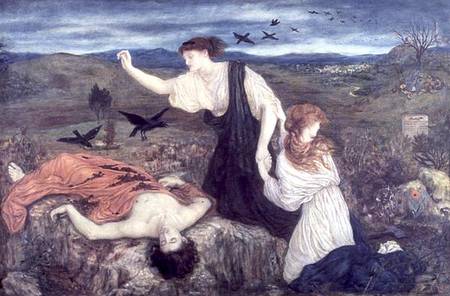
[WARNING: SPOILERS] I've mentioned this before, but Antigone by Sophocles is, like, my most favouritest Greek tragedy ever. Her almost desperate struggle, caught between institutions, laws and ideals is not only heart-wrenching, but also indicative of the awareness in Classical Athens of the disparity between the requirements of law, moral behaviour and their own religion. Although you might wonder how different this play would be if the protagonist was a man, in essence it remains desperately tragic, in, for me, the best way possible.
Marie Stillman - Antigone
The essential plot: Antigone and Ismene are the daughters of Oedipus (the unfortunate King of Thebes). Upon his death (in the Sophoclean version), their uncle, Creon becomes king. Their two brothers, Polynieces and Eteocles, are fighting over Thebes and kill each other. (Ah, lovely tragedy). Creon allows the burial of Eteocles, but forbids the same honours for Polynieces and leaves his body to rot outside the gates of Thebes. Antigone, obeying the religious law that a sister should bury her brother, sneaks out and buries him, disobeying not only her family, but also the King, the maker of laws and is punishable by death. She is caught and brought before the king. She does not beg for mercy, only for justice in the name of sisterly love. Creon sends her away to become the "bride of death" (ie be buried alive in a wedding dress), as she has transgressed the word of the law and so must be punished. Unfortunately, Creon's son was to be Antigone's husband, and begs the King to repent. Being a hardline, no-nonsense monarch, of course, he refuses, until a wandering seer warns of him of his mistake and that tragedy will befall Thebes. But too late! Antigone has hanged herself in her rock tomb, the King's son, on finding her, kills himself, and the Queen, on hearing of her son's death, kills herself. As you do.

... Summarising it like that makes it sound incredibly far-fetched. But the way the play feels, is pure heart-breaking emotion. Creon is obviously too hard on his own kin and makes the mistake of following the law to the letter. But isn't that what the law is there for? To be followed absolutely, with no exceptions, otherwise, wouldn't everyone be able to plead an exception?

Creon: I will not make myself a liar to my people. He who does his duty in his own household will be found righteous in the state also. [658-660].

Antigone, above all, raises the issue of divine law versus secular law. She obeys the laws of the gods, who require that both brothers are buried with equal rites by the next of kin. So surely, in a time when divine law judged mortal law, she is not culpable? Creon has created a Catch-22 for himself by proclaiming death for anyone who interferes, only to find that it is a member of his own family.

Antigone: ... That a mortal could override the unwritten and unfailing statues of heaven for their life is not of today or yesterday, but from all time, and no man knows when they were first put forth. [450-458].

To put this in context, Athenian tragedy, as a genre, was intended to question morality. It was not necessarily a reflection of real life, but was meant to pose a question, a "what would you do if ..." situation. The play itself was written c.442BC in Athens. This was the time of the 'radical democracy', when Athens was at war with Sparta, encountering the public burial of war dead and justifying the polis' democratic position, combining both the written laws of the constitution and the unwritten laws that were divine, moral or assumed.

But as well as all that, to me, it really will always be a gorgeous, tragic and beautiful play.

Attic Red Figure, Antigone is brought before Creon c.490BC (?) Looks like a krater ...

Thursday, 14 April 2011

Bossy Women

Just to make how I feel about women absolutely clear before I start this. I am a woman. I have female friends. I have male friends. Women are lovely, but they can also be right pains. The same can be said for men. I am not a feminist. I am a gender equality-ist. It doesn't enrage me that women in history have been badly treated, because that's history. So long as it doesn't happen again.


Right, so here's a thought I had this morning as I was sitting down to breakfast and Jeremy Kyle. (oops). Today's society is outstandingly matriarchal. I'm just talking about western society, Britain in particular, I'm not getting into any discussion about particular religions' attitudes towards women or the treatment of women in other countries. But it does seem to me, that in the household, as the centre of each individual's both private and public society, women rule.


It's like, on a lot of these chat shows, (ok, I admit it, I'm just using Jeremy Kyle as an example), the 'head woman' of the household can be so incredibly controlling and dominant. They have the final say on who their son/daughter is allowed to see, who is 'in' and who is 'out' of their household. They can be bossy and domineering, (but of course there are counter-examples of completely down-trodden women). But the majority of women today, I think, do have a fair amount of control, both in the household and the workplace.


Obviously, this wasn't always the case. Women in the Classical Greek world had no rights to speak of. In fifth and fourth century Athens, women could not give evidence in the jury-courts and they had no rights to property. Their position was not even as head of household, but they belonged to the oikos, the household and to their husband, as can be seen in the trials and speeches of Demosthenes. Even when women apparently gain power in Aristophanes' comedy Ekklesiazusai, the very idea of women in such a role is  comedy in itself. The women then essentially create a welfare state that feeds and cares for every Athenian citizen and a kind of 'sexual socialism'. Unusually enough for Aristophanes, the situation is never resolved, but it is clear that the very concept of a matriarchal society for the Athenians was completely ludicrous. 


Antigone, by Frederic Leighton 1882, looking all Pre-Raphaelite-y.
Then there is my absolutely all-time favourite Greek tragedy EVER: Sophocles' Antigone. Antigone acts against the laws of the king, her uncle, in burying her dead brother, yet acts in complete agreement with the laws of kinship and of the gods. Therefore she must suffer the consequences and tragedy occurs. It was, of course, the duty of a sister to give her brother the correct funeral rights, but we might wonder if the same events would have occurred if it was a man in her place, or whether it really is the fate of the family of Oedipus to end in utter tragedy.


In the material evidence, women in ancient Greece were goddesses, or korai, (archaic statues with essentially, no personality) and were rarely depicted as individuals until the mid-fifth century, and even then they were dumpy, even masculine in features [Polyxena stele c.440BC]. Even when women were truly represented as 'women' it was always in a domestic context, with a husband, slave or child:

Hegeso stele c.400BC. If she stood up she'd be taller than the stele itself, plus her breasts are all crazy-wonky.


A similar picture can be drawn for ancient Rome. Although we might get the impression that Roman women were much more liberated, and TV series like Rome might give us the impression that they regularly interfered in politics and threw orgies. (One I saw a bit of recently, Spartacus: Gods of the Arena definitely gave that impression. I only saw a little of it, but spent the entire time wishing they'd hurry up with the orgy. Oh dear... Apparently it was given 9.5/10. This makes me a little sad). 

Yet the Senate remained male, during the Imperial period, the Emperors were male and women remained subordinate; matrons of the state. Cornelia Scipionis Africana, daughter of the famous Publius Cornelius Scipio Africanus was seen almost as the ideal Roman woman. She was the mother of the ill-fated Gracchi; the widow who refused to re-marry, even when proposed to by the King Ptolemy VIII Physcon, the supporter of her children and student of Greek and Latin literature, all of which were, despite her prominent role in the second century BC, subordinate positions.

The wives of the Emperors especially were expected to maintain the image of dutiful wives and as examples of good Roman women. Augustus' wife, Livia, despite her husband's apparent reputation was seen as a pious matron, although later craving power on behalf of her son, Tiberius.

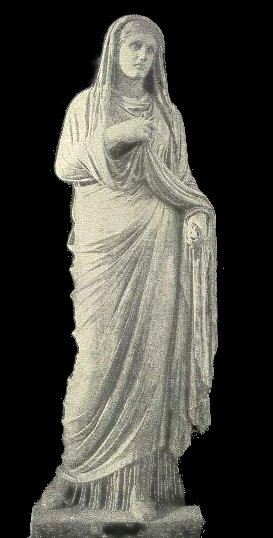
Women were certainly never forgotten, but were side-lined and a certain duties and actions were expected of them. Even during the Hellenistic period they remained subordinate, yet it is in this period, in Ptolemaic Egypt, that we actually see the prominent role of women. The (often) sister-wives of the Ptolemies were treated as divine humans in their own right. Roman empresses were worshipped as part of their ruler cult, but so were the queens of the third and second centuries BC. Yet the royal couples were still represented as a family. Women were able to branch into the male sphere of euergetism and munificence, and this is how we see the prominence of women in ancient Rome. Eumachia was able to dedicate a building to Concordia and Pietas (peace and piety - womanly virtues, perhaps?) in the Forum at Pompeii. Plancia Magna financed the re-building of an entire city gate in Perge. These were successful women, able to publicly display their own wealth, so long as it was beneficial to others, yet they had both been priestesses of Venus and of Artemis respectively, and so keeping to roles deemed appropriate for women.
Eumachia statue, Pompeii, first century AD. She is veiled in a pudicitia pose; appropriate for a woman, even an affluent one.

Perhaps it is through looking at women in ancient history anachronistically that I am even able to consider calling today's society a matriarchy. I realise that this is not a true 'matriarchy', but when looking at past evidence, it is certainly possibly to see that a number of women today possess 'matriarchal aspirations' that it was once never possible to even consider holding. Perhaps the only reason why we do not live in a matriarchal society today is because we still perceive matriarchs as the bossy mothers on Jeremy Kyle and as "bra-burning" feminists. Just a thought ...

This has turned into an incredibly long piece, which is er, slightly ironic, seeing as I actually really dislike the theme of women in history. I feel that it's important to understand what role they played and why they were seen as subordinate. But I do think that it's unnecessary to base entire essays on the subject as though it's a surprise. (In A Level History, I had to write essays on the role of women in Stalinist Russia. I feel like that is kind of missing the point of the subject itself). The same can also be seen for women in ancient history, but because material and inscription-al evidence is often so sparse, we feel the need to illustrate and explain points that we might otherwise see as quite common sense. 

Wednesday, 6 April 2011

Too Much?

This is specifically for a friend of mine, who apparently didn't want to see dinosaurs with boobs on his browser. I'm actually in the middle of writing some intelligent posts and revising the Hellenistic East, but whatever ...


Monday, 28 March 2011

If Dinosaurs Had Pets ...

This is what happens when I revise in my own room.

(Un)fortunately there are a lot more where this came from ...

Sunday, 27 March 2011

So I Decided to Make a Blog

I'm Hannah. I'm an Oxford undergraduate and I have finals. So I decided to make a blog. Maybe as some kind of revision aid, but probably as extra procrastination.

I'm studying Classical Archaeology and Ancient History and apparently like it enough to proclaim this pretty openly.

How best to start? Perhaps a summary of who I am and what I like ... ?

Dear Hannah,
I have some questions for you, please answer them.
All the best,
Hannah

Why did you decide to make a blog? Because I enjoy archaeology, ancient history and writing. I especially want to combine all three and get other people to learn about them. (If I'm totally honest, a few friends have been making their own blogs and I thought I might as well get in on it and maybe do it better ... *bad Hannah*)
Do you often talk to yourself like this? Yes. A lot. Some of the best conversations I have are with myself. Some of the best showers I've had have been at 2am.
Favourite areas of archaeology? Roman Art, Roman Architecture. Human sculpture. Attributing meaning to images. Political "propaganda".
Do you like digging in a hole in the ground? YES! Find me more holes!
Plans for the future? Become Indiana Jones. Maybe with fewer Nazis. Steal Tony Robinson's job and become best friends with Bettany Hughes (honestly not in such a creepy way as I'm making it sound). Dig up awesome things. Realise it's all futile and that I've technically been unemployed for 10 years and that my best friend is just a cardboard cut-out that I've been force-feeding it tea and biscuits every day and become a teacher. (I actually wouldn't mind becoming a teacher, I'd just like to do other things first. Not necessarily involving cardboard cut-outs).
Urm, right ... anything else we ought to know? Sure. I like dinosaurs (a lot). And rocks. And ginger wine. And collecting postcards. And Disney films (perhaps more than a 21 year old should). I like making a fool of myself in pantomimes and filing things away neatly. I like spring, soup and cycle rides. I live on a smallholding with goats.
Well. Everything's a LOT clearer now ... Thanks for that Hannah. No problem Hannah. Any time.

Hopefully that makes more sense...

Plan for these blogs? Promote interesting aspects of what I'm studying, either through what I'm learning about each week, revising (or failing to), or some interesting article in the media. If I'm completely honest, there will almost definitely be inappropriately history-related links to pretty pictures, not-particularly-Roman gladiators and maybe even a little Harrison Ford. But that's only if I'm feeling *really* inappropriate. Ohhooo.